Payments
How to Set Up a Decentralized Cloud VM with Aleph CLI
Deploy a decentralized VM in 10 minutes with Aleph Cloud's Rust CLI. Install, fund with USDC/ALEPH, launch Ubuntu instances for ~$10/month, and SSH in. No Python, no centralized cloud.
10 min. read -
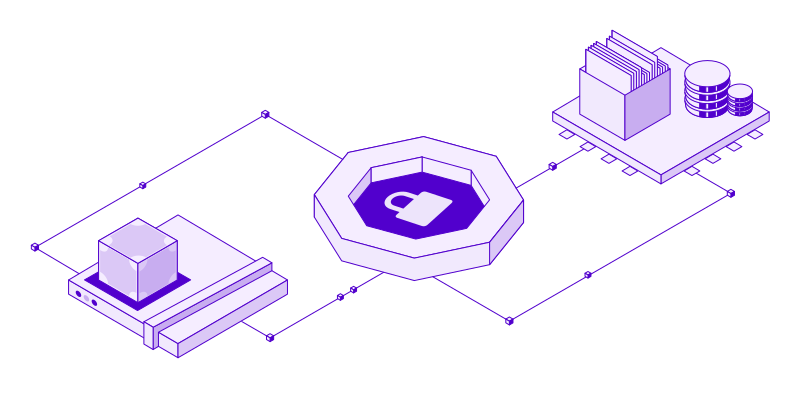
Table of contents
Why decentralized cloud changes everything?
From chatbots to autonomous teammates
The infrastructure problem: agents are not just another workload
Why OpenClaw and Aleph Cloud are such a natural fit?
The AI wave has moved past chat interfaces and static models. We’re now entering the era of autonomous agents systems that don’t just gather data, but act on it: scraping, analyzing, reacting, and orchestrating across distributed systems.
And while many still treat web automation as a “quick script,” the next generation of agents is designed for resilience, privacy, and scale.
Enter OpenClaw, the open-source framework for intelligent web agents, and Aleph Cloud, the decentralized infrastructure engineered to run them.
Together, they unlock a new class of AI-powered web operations: always-on, censorship-resistant, globally distributed, and cost-optimized.
Aleph Cloud isn’t just another cloud provider. It’s a decentralized compute and storage layer built on:
This shifts the model from “running code on someone else’s server” to “running agents on the network itself.”
Feature
Centralized Cloud
Aleph Cloud + OpenClaw
Storage
Centralized buckets (S3, Blob)
Content-addressable (immutable, verifiable)
Execution
VM/container pools
Edge-anchored, on-demand compute
Uptime
SLA-bound, regional outages
Globally redundant
Data Control
Provider holds keys
You retain cryptographic sovereignty
The result? Agents that are self-contained, tamper-resistant, and portable.
OpenClaw did something deceptively simple: it glued all the hard parts of agents together.
Instead of another web UI, OpenClaw runs on your machine (Mac, Windows, Linux) and lives where you already are – WhatsApp, Telegram, Discord, Slack, Signal, iMessage. It remembers your preferences, your projects, your documents. It controls a browser, reads and writes files, calls APIs, runs shell commands, and extends itself with “skills” and plugins.
In other words, it behaves less like a chatbot and more like a highly competent teammate sitting at a real computer.
Users are already:
Now extrapolate: not one OpenClaw, but dozens or hundreds of them, each with persistent memory, connected tools, and authority to act. These are the raw ingredients for autonomous organizations, personal AI “operating systems”, and fully automated digital back offices.
But this creates a new class of infrastructure requirements that traditional, centralized clouds do not handle well.
Running modern AI agents at scale is fundamentally different from serving a web app or an API.
Autonomous agents:
On a legacy cloud, that usually means:
For one hobbyist OpenClaw instance, this might be tolerable.
For a network of always-on agents that touch sensitive data, it is not.
This is where Aleph Cloud’s decentralized architecture aligns almost perfectly with what OpenClaw-style agents want by design.
Deploy your own confidential VM
Follow our guide to set up secure, AMD SEV-powered Confidential Virtual Machines and protect your data.
Aleph Cloud was built as an AI Supercloud: a censorship-resistant, multi-chain, hardware-verified alternative to traditional cloud services.
For AI agents like OpenClaw, that translates into a few critical properties:
1. Confidential compute by default
Agents will routinely see data that humans would never put into a centralized SaaS: raw inboxes, medical documents, contracts, internal chat logs.
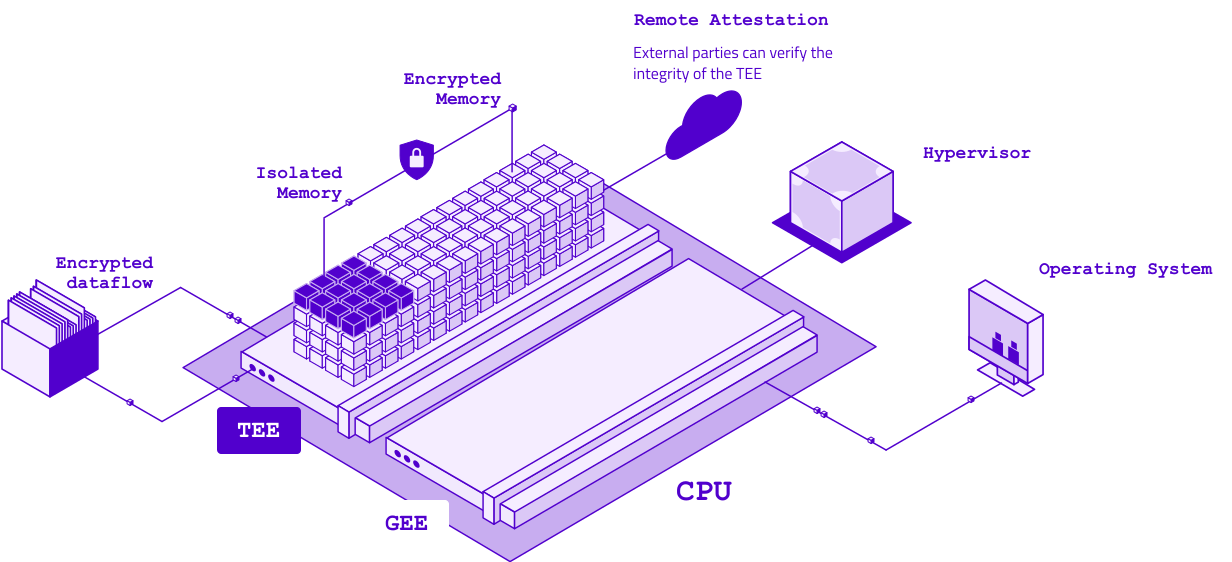
Aleph Cloud uses Trusted Execution Environments (TEEs) and hardware-based attestation so that data stays encrypted even while it is being processed inside virtual machines.
This allows builders to design OpenClaw deployments where:
For teams in the EU and beyond who care about GDPR, banking, or health data, this is the only realistic path to “always-on agents that actually see everything” without compromising sovereignty.
2. Decentralized GPU power for agent swarms
Autonomous agents are not just about language. They need:
All of this adds up to serious compute demand, especially when multiplied across many agents.
Aleph Cloud’s decentralized GPU marketplace gives builders a way to tap into global GPU capacity at a fraction of centralized hyperscaler pricing, while still benefiting from familiar primitives like VPS, block storage, and serverless functions. That turns “hundreds of OpenClaw instances” from a science project into a viable production deployment.
3. True data localization and sovereignty
One of the key promises of Aleph Cloud is that you choose where your data lives.
For AI agents, “where” is not just a compliance checkbox – it defines who can access logs, memories, intermediate outputs, and model prompts. With Aleph Cloud, organizations can:
For enterprises in Luxembourg, across Europe, and globally, this creates a comfortable foundation to experiment with deeply integrated agents without handing the keys to a distant data center governed by another jurisdiction.
4. Censorship resistance and composability
Autonomous agents are only as powerful as the tools they can reach.
Because Aleph Cloud is composable and modular, it can sit at the intersection of Web2 and Web3, bridging:
That means an OpenClaw agent running on Aleph Cloud can, in principle, read encrypted data, call DeFi protocols, coordinate on-chain governance, sync with Web2 apps, and surface all of this back to humans in their everyday chat apps.
And because the underlying compute is censorship-resistant, builders are not at the mercy of a single provider’s product roadmap or policy changes.
OpenClaw is famously “infrastructure you control”. It is open source, hackable, and hostable on-prem. That ethos lines up almost perfectly with Aleph Cloud’s mission: cloud sovereignty for every builder.
Putting them together unlocks a few compelling patterns:
Run a primary OpenClaw instance close to your device, then offload heavy tasks to Aleph Cloud GPU nodes via skills and plugins.
Deploy OpenClaw agents per team or function (sales, ops, engineering), host them on Aleph Cloud VMs in specific regions, and use confidential compute to ensure that only the right data flows into the right agents.
Startups can build entire offerings around OpenClaw-powered agents, using Aleph’s pay-as-you-go decentralized infrastructure to avoid massive upfront costs and lock-in. Agents become your “digital staff”; Aleph Cloud becomes their office.
Combine on-device models and local OpenClaw instances with Aleph Cloud-based backends for heavy lifting, long-term memory, and compliance-sensitive workflows.
Payments
Deploy a decentralized VM in 10 minutes with Aleph Cloud's Rust CLI. Install, fund with USDC/ALEPH, launch Ubuntu instances for ~$10/month, and SSH in. No Python, no centralized cloud.
Computing
Aleph tokenomics introduces a dual-stream rewards model for decentralized cloud operators: a transitional reward floor plus a usage-based revenue share.
Payments
Pay As You Go and Holder Tier payments are officially deprecated. Aleph Cloud now runs on a single credit system. Top up with USDC, fiat, or ALEPH and pay for what you use.
Virtual Machines
Explore how OpenClaw AI agents, and Aleph Cloud’s decentralized AI Supercloud are redefining autonomous computing with sovereign, censorship-resistant infrastructure.